

Agile computer system validation methodology for agencies
Agile delivery and disciplined validation can work together. An agile computer system validation methodology integrates risk assessment, requirements traceability, testing, and documentation into each development iteration. Validation effort is then scaled to the system’s GxP risks and intended use. This lets teams adapt as requirements evolve while keeping evidence linked to critical functions.
Moving quickly does not remove the need to protect data integrity, product quality, and patient safety. The practical approach is to build validation into the work instead of treating it as a final approval step.
This article explains how agencies can apply risk-based Computer Software Assurance, use automated tests with traceable evidence, and maintain agile requirements and artifacts. You’ll also see how GAMP 5 principles can support an iterative lifecycle, helping teams make controlled changes without losing audit readiness.
Table of Contents
Computer software assurance (CSA) as a risk-based alternative
Computer Software Assurance focuses validation effort on software functions according to their potential impact. In Agile development, this helps teams align assurance activities with system risks and intended use.
Risk identification and validation planning
Risk identification assesses how software functions could affect patient safety, product quality, or critical processes. The assessment informs validation scope and test depth. Identify critical functions before development, evaluate their potential impacts, then define testing criteria and evidence needs. For example, a function that controls a GxP decision may require documented testing of expected behavior and failure conditions.
Requirements traceability and risk management
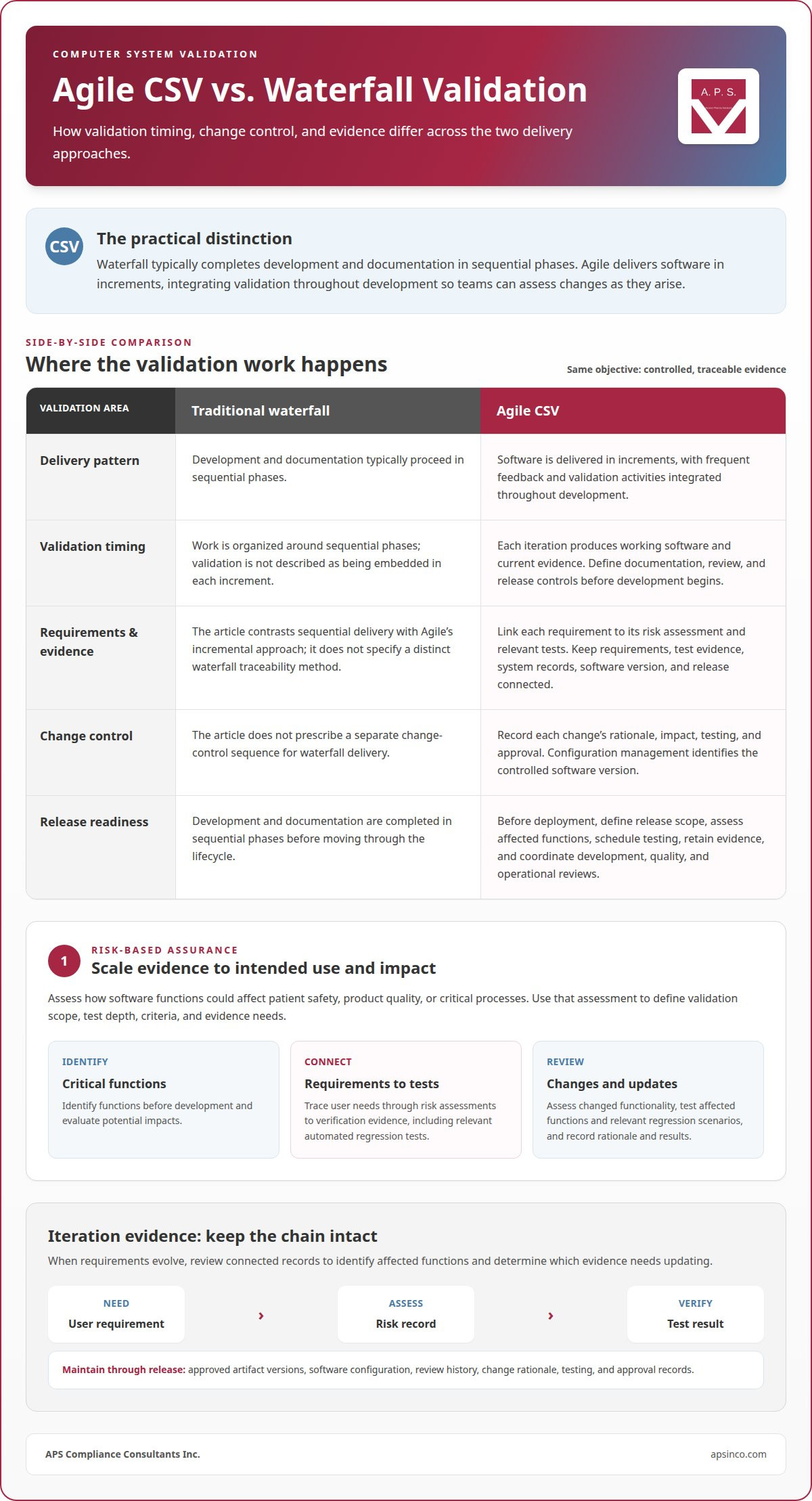
Requirements traceability links user needs to risks and verification evidence throughout development. This helps teams demonstrate how critical requirements were addressed as the software changed. Link each requirement to its risk assessment and relevant tests, including automated regression tests. When a requirement changes, review those connections to identify affected functions and determine which evidence needs updating.
SaaS updates and revalidation
Risk-based revalidation evaluates the effects of a SaaS update and adjusts assurance activities to the change. Because updates can affect functions differently, review the release information, identify changed functionality, and assess its impact on intended use. Then test affected functions and relevant regression scenarios, recording the rationale and results to support a controlled update decision.
Agile CSV risks and audit findings
Common Agile CSV risks include unclear requirements, weak traceability, and missing or outdated test evidence. These gaps make it harder to demonstrate how risks were assessed and changes controlled. Prevent them by defining validation responsibilities and procedures, linking tests to requirements and risks, and updating records as work progresses. Reviewers can then follow the rationale from requirement through test result to release decision.
Key Question: How Can Agencies Incorpoate Agile Principles?
Integrate validation into development so each iteration produces working software and current evidence. Define documentation, review, and release controls before development begins.
Reduced documentation and vendor evidence
Reduced documentation means recording evidence that supports intended use and risk decisions, rather than creating repetitive paperwork. Teams still need enough evidence to demonstrate control without duplicating reliable vendor testing. Assess vendor-provided qualification documents against system functions and intended use. Use relevant evidence for functional verification, document any gaps, and perform additional testing where needed.
Version control and continuous documentation
Continuous documentation keeps requirements, test evidence, and system records current as the product changes. Version control identifies the approved state of each artifact and its relationship to a software release. This allows teams to reconstruct which requirements and tests supported a deployed configuration. Maintain traceable records in each iteration, review changes, and preserve approval history for release decisions.
Agile and waterfall validation
Traditional waterfall validation typically completes development and documentation in sequential phases. Agile delivers software in increments, with frequent feedback. In Agile CSV, validation activities are integrated throughout development rather than deferred to a final phase, helping teams assess changes as they arise. Change control should record each change’s rationale, impact, testing, and approval. Configuration management should identify the controlled software version.
Implementation resources and timelines
Implementation resources and timelines depend on system complexity, risk, integrations, available vendor evidence, and team readiness. No single timeline fits every project. For each release, define scope, assess affected functions, schedule testing, and retain evidence before approving deployment. Release planning should coordinate development, quality, and operational reviews. To shape a validation approach around your system, discuss your CSV requirements with the team.
Agile artifacts and requirements
In Agile development, requirements and validation evidence take shape alongside working software. An agile computer system validation methodology organizes these artifacts around evolving increments while preserving the rationale for decisions and the evidence supporting each release.
Start with user requirements that describe intended use in operational terms. For a laboratory application, a requirement might define how authorized users record and review analytical results. Quality Assurance should participate from the outset, helping teams identify GxP functions, acceptance criteria, and evidence needs before implementation. This makes validation part of the product, not a final documentation task.
Product backlog items translate broader needs into technical work delivered through releases and sprints. The team reviews and selects suitable items for the sprint backlog, then records acceptance criteria that developers and testers can assess. For example, a story about reviewing a result can specify the user action, expected system response, and evidence needed to demonstrate that response. Keep each item clear enough to guide design and testing.
Useful artifacts include approved user requirements, design information, risk records, test results, and maintenance documentation. An agile computer system validation methodology connects each requirement to its design and verification evidence, and identifies the software version and release associated with those records. When a story changes, update affected artifacts so the approved system state remains clear.
Traditional validation often organizes deliverables around sequential phases; Agile teams maintain the same core validation deliverables through iterative work. At sprint reviews, confirm completed requirements, test outcomes, unresolved defects, and documentation updates. This gives stakeholders a practical view of the increment’s functions and the evidence supporting them. Clear artifact ownership and collaboration help keep records usable for maintenance, release decisions, and audits.
What are the key principles of risk-based agile CSV?
GAMP 5 provides a structured framework for applying risk-based validation to Agile software development. Begin with intended use, then identify functions that could affect patient safety, product quality, or critical data. Use those risks to set validation depth, test methods, and evidence expectations. This keeps assurance focused on system impact, not sprint speed.
Classify software using GAMP 5 categories: Category 1 covers infrastructure software, Category 3 non-configured products, Category 4 configured products, and Category 5 customized applications. The category helps frame the assessment, but it does not replace intended-use and risk analysis. For example, a configured workflow still needs testing where it supports a GxP decision. Document why selected controls match each function’s risk.
Apply these principles in every iteration. Review changed requirements, assess impacts, and select tests before accepting the increment. A calculation that determines a laboratory result may need documented, risk-focused testing, while a non-critical display change may call for different evidence. In both cases, record the rationale, results, defects, and approval against the relevant version. This makes release decisions explainable and keeps validation evidence aligned with actual system behavior.
Keep Quality Assurance, developers, testers, and process owners involved throughout the lifecycle. Their collaboration helps surface risks early and resolve unclear acceptance criteria before release. Define roles, review points, and escalation paths in the quality management system, then apply them consistently across sprints. For a SaaS update, assess changed functions and affected workflows before deciding what testing supports continued use. Discuss risk-based CSV support to establish a validation approach suited to your system and intended use.
APS Compliance Consultants Inc.: Computer System Validation (CSV)
APS Compliance Consultants Inc. provides Computer System Validation (CSV) for teams implementing or maintaining software in GxP-regulated environments. Turn to its CSV services when you need to align an Agile development lifecycle with validation planning, risk assessment, testing, and controlled documentation.
APS Compliance Consultants Inc. works collaboratively with your team to define evidence around intended use and critical functions, connect requirements with verification, and assess the validation impact of system changes. This approach helps maintain traceable records as software evolves, while keeping quality and data integrity central to release decisions. Equipment Qualification (IQ/OQ/PQ) is also available when the validated process involves laboratory or production equipment.
Make Your Next Validation Cycle Work Better
The next step is to make an agile computer system validation methodology a repeatable operating practice. Set clear ownership for validation decisions, define how changes enter review, and make evidence maintenance part of routine release work. These controls help teams sustain compliance as software and processes evolve, rather than treating validation as a project that ends at go-live.
APS Compliance Consultants Inc. offers Computer System Validation (CSV), Alleye CMMS Software, and Equipment Qualification. Choose support that fits your operational need, whether you are validating a computerized system or addressing equipment qualification within a regulated process.
Bring your validation priorities and current challenges into a focused discussion. Contact APS Compliance Consultants Inc. to explore a practical next step for your team.
Frequently Asked Questions
What do the regulations say?
Regulations address system suitability, controlled operation, and dependable records; they do not require one universal software development sequence. The European Union states that regulations (EU) 2017/745 and (EU) 2017/746 do not prescribe a particular software design or development sequence. For a regulated project, identify applicable requirements, then document how the organization’s quality procedures govern system decisions and evidence.
What is the Agile Methodology?
Agile is a family of software development approaches, including Scrum and Kanban, with different ways to organize work. Scrum commonly uses defined team roles and planning events, while Kanban visualizes work as it moves through stages. The choice affects how a team coordinates tasks and feedback, but does not by itself determine the validation records or controls a regulated system needs.
What is the Agile model in Computerized System Validation?
The Agile model in computerized system validation describes how validation fits a project that delivers software in increments. Some regulated projects use iterative development followed by a final validation phase before production release, including Performance Qualification. This can provide a distinct readiness review after development is complete. The project’s validation plan should explain how incremental evidence supports the final release decision.
What is agile computer system validation (CSV)?
What FDA regulations and guidance apply to agile CSV in the United States?
FDA 21 CFR Part 11 may be relevant when a regulated system uses electronic records or electronic signatures within its scope. FDA Computer Software Assurance guidance is also relevant to assurance planning. Applicability depends on the system’s use and the records it handles. Map those features to the organization’s procedures, then document how controls support trustworthy records and appropriate access.
How does FDA Computer Software Assurance guidance relate to agile CSV?
FDA Computer Software Assurance guidance relates to how organizations plan and document assurance; it is not an Agile project-management method. Teams can record why a test approach suits a particular function and retain the resulting evidence. Exploratory testing can complement scripted checks when teams need to probe unexpected behavior, with findings documented for review and follow-up.


Comments