

Alcoa Plus Principles and Pharmaceutical Data Integrity
Pharmaceutical data integrity depends on more than accurate results. Each record must be attributable, legible, contemporaneous, original, and accurate, as well as complete, consistent, enduring, and available. Together, these nine attributes form ALCOA+, a practical framework for trustworthy data throughout its lifecycle. With the ALCOA plus principles explained in practical terms, it becomes clear how timely entries and traceable changes support reliable decisions and audit readiness.
Applying these principles means preserving the full story of an activity, not just its final report. A record should show who performed the work and when, retain relevant source data and metadata, and present events in a logical sequence. This guide explains each ALCOA+ attribute and how the principles apply to pharmaceutical records, including repeat analyses, corrections, and electronic data. You’ll see how completeness and consistent timestamps make records easier to review and more dependable for quality and compliance decisions.
Table of Contents
What is Data Integrity in Pharmaceuticals?
Pharmaceutical data integrity means records remain complete, consistent, and accurate throughout their lifecycle, from initial capture through review, retention, and retrieval. It matters in manufacturing, quality control, research laboratories, and universities whenever records support regulated decisions. A balance entry, sample result, or equipment log must reliably represent the activity performed.
The ALCOA+ principles explained with examples describe nine attributes for trustworthy records. The FDA’s December 2018 data integrity guidance defines data integrity through completeness, consistency, and accuracy. ALCOA+ gives teams practical criteria for assessing how records are created, changed, preserved, and reviewed.
Attributable: A named user records a batch check under their own account.
Legible: A laboratory notebook entry remains readable throughout retention.
Contemporaneous: An analyst records a measurement when the test occurs.
Original: The source instrument file is retained with its report.
Accurate: A result reflects the instrument reading and approved method.
Complete: The record includes repeats, rejected results, and explanations.
Consistent: Entries and timestamps follow a logical sequence.
Enduring: Records remain preserved on controlled media.
Available: Authorized reviewers can retrieve records for examination.
In pharmaceutical manufacturing, these attributes apply throughout the data lifecycle. For example, a production record connects the operator, equipment, time of activity, and result. If an entry changes, an audit trail should identify the change and the person who made it. Retaining source data and relevant metadata helps reviewers understand how a reported result was generated, not just what the final report states.
Training, audits, and management oversight make these practices part of daily work. A training exercise can ask staff to document a correction without obscuring the original entry. Internal audits can examine whether records include repeat analyses and traceable changes. Managers can review findings, assign corrective actions, and assess whether procedures, systems, and staff practices support data integrity in pharmaceutical companies, universities, and laboratories.
Contemporaneous: Was the data recorded at the time of the activity?
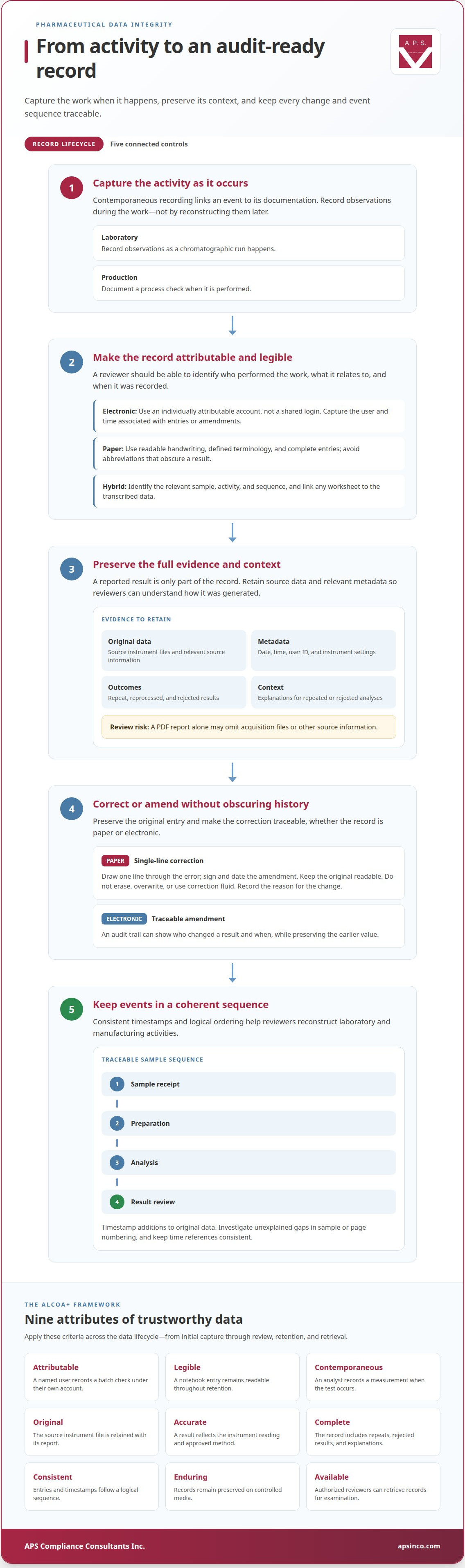
Contemporaneous recording means entering observations as work occurs, not reconstructing records afterward. This applies to paper, electronic, and hybrid records across pharmaceutical operations. During a chromatographic run, an analyst records observations as they happen. A production operator documents a process check when it is performed. Reconstructing records later can weaken the link between an event and its documentation.
Paper records need clear entries made at the time of observation. To correct an error, draw a single line through it, then sign and date the amendment. Keep the original entry readable; don’t erase, overwrite, or use correction fluid. For example, when correcting a transcribed sample identifier, an analyst preserves the original text and records the reason for the change.
Electronic records can capture the user and time associated with an entry or amendment. Each person should use an individually attributable account, not a shared login. An audit trail can show who changed a result and when while preserving the earlier value. Where practical, record data directly in the validated system instead of transferring it later from loose notes.
Hybrid records combine paper and electronic evidence, so their relationship must remain clear. A handwritten instrument observation may support an electronic result, but the record should identify the relevant sample, activity, and sequence. If a paper worksheet is transcribed into a system, traceability should link the worksheet to the entered data and explain any discrepancy.
Legible records must remain intelligible during review and retention. Use defined terminology, complete entries, and readable handwriting; avoid unexplained abbreviations that obscure a result. During audits, reviewers should be able to follow the activity from its recorded time through any correction or electronic transfer. If your procedures need clearer controls across record formats, discuss contemporaneous recordkeeping.
Completeness and chronological consistency
Complete pharmaceutical records preserve relevant results and their context, while chronological consistency makes event sequences traceable. Together, these practices support reliable data management and review against applicable guidelines.
Completeness and Metadata
Completeness means retaining the original data, associated metadata, and relevant outcomes, including repeats, reprocessing, and rejected results. Metadata such as date, time, user ID, and instrument settings helps explain how a result was generated. A PDF report alone may omit acquisition files or other source information. In a regulated laboratory, preserving those records lets reviewers assess the work behind the reported result and understand why an analysis was repeated or rejected.
Chronological Consistency
Chronological consistency means arranging related entries in a logical sequence with coherent timestamps. For example, sample receipt, preparation, analysis, and result review should be traceable in the order they occurred. Additions to original data need timestamps, and unexplained gaps in sample or page numbering can make a sequence difficult to interpret. Consistent time references help reviewers reconstruct manufacturing and laboratory activities without confusing later corrections with the original work.
These practices connect with regulatory references across jurisdictions. The FDA references 21 CFR 211.194 in connection with complete data and records. The World Health Organization identifies data integrity as fundamental to GMP in WHO TRS 996, Annex 5. PIC/S PI 041-1, dated 1 July 2021, addresses data management and integrity in regulated GMP/GDP environments. Together, these references make complete, traceable records relevant to pharmaceutical operations beyond one market.
Missing metadata, omitted repeat results, or unclear event sequences can weaken investigations and inspection readiness. Data gaps may also contribute to warning letters or product recalls. For example, if a manufacturing result was rejected but the record and rationale are missing, reviewers cannot follow the decision. Controlled capture, consistent formats, and documented explanations help preserve the evidence needed to assess that decision.
Consistent event sequences and time references
A reliable record lets reviewers reconstruct an operation in the order events occurred. Consistent time references make that sequence understandable across instruments, worksheets, and review records. If an equipment alarm appears after a corrective action in the record, the timeline may misrepresent events and complicate an investigation.
Consider a temperature excursion during a manufacturing operation. The record should show when the alarm occurred, when staff responded, and when the equipment returned to use. Each entry needs a clear time reference, and any later addition should be distinguishable from the original entry. This sequence helps reviewers assess the event without relying on memory or assumptions.
Different systems can record time in different formats. A laboratory instrument may use one display, while a manual log uses another convention. Define a consistent format in procedures, make time references readable, and explain any necessary conversion. When several records describe the same operation, identifiers such as the equipment name or batch reference help connect the events.
Sequence checks also matter when records contain numbered pages, samples, or operations. An unexplained gap in a sample sequence may leave reviewers unsure whether a record is missing or an activity was skipped. A documented explanation preserves context. Likewise, a correction entered later should not appear to have occurred before the event it describes.
ALCOA+ is a framework for assessing whether data remains trustworthy across records. Its acronym includes consistency, while the broader principles call for complete and available evidence. In practice, reviewers should be able to follow an event from its initial record through later review, correction, or investigation. Clear procedures and staff training help maintain these practices in routine work and audits.
If inconsistent timestamps or event sequences are making records difficult to interpret, discuss data integrity support.
APS Compliance Consultants Inc.
APS Compliance Consultants Inc. helps pharmaceutical, biotechnology, and medical device teams address data integrity risks through validation and qualification services. Turn to APS when system controls, equipment records, or data workflows make it difficult to demonstrate attributable, complete, and traceable records.
Computer System Validation (CSV) establishes documented evidence that computerized systems perform their intended functions. Equipment Qualification (IQ/OQ/PQ) addresses whether equipment is suitable for its intended use. ALLEYE CMMS software supports maintenance management, while PharmaRockIT LIMS supports laboratory data workflows. The appropriate work depends on the systems, equipment, and records involved.
Put Data Integrity Into Daily Practice
Understanding the ALCOA plus principles explained in operational terms is a starting point. Sustained integrity depends on how procedures, systems, and oversight work together. Translate the principles into clear controls for records that support critical quality decisions: define who owns each record, how changes are traced, and how teams review data throughout its lifecycle.
Use a risk-based approach. Prioritize records and systems where missing context or an unclear sequence could affect a GxP decision. Then use routine oversight to identify patterns, address gaps, and refine controls as processes change. This keeps data integrity connected to everyday laboratory and manufacturing work, rather than treating it as a one-time documentation exercise.
If you’re ready to strengthen how your organization manages regulated data, start a conversation with APS Compliance Consultants Inc. A focused discussion can help define a practical next step for your records, systems, and quality processes.
Frequently Asked Questions
ALCOA+ - what does it mean?
ALCOA+ is a shared framework for evaluating whether GxP records can support decisions throughout their lifecycle. It helps quality and laboratory teams translate broad data integrity expectations into procedures, system requirements, and review criteria. For example, a procedure can define how a result is approved and what evidence must accompany that approval, giving staff a consistent basis for documenting work.
Accurate: Does the data reflect the actual event?
Accuracy means the recorded value faithfully represents the event or measurement, including its units and context. For example, a balance record showing a mass should match the source reading and preserve the unit used. Reviewers can also assess whether calculations follow the approved method and reported values were transcribed correctly, rather than relying only on the final entered figure.
Attributable: Who created or modified the data?
Attribution should let reviewers distinguish the person who performed an activity from the person who checked or approved its record. For example, a controlled worksheet can include separate fields for operator and reviewer, with each person identified through the site’s approved recording method. This clarifies responsibility when a result is questioned and helps quality teams direct follow-up to the appropriate role.
Enduring: Can the data last for its entire required lifespan?
Enduring records remain usable, not merely stored, for the required retention period. Consider a file that depends on a retired application: preserving the file alone may not preserve its meaning. Retention planning should account for the information needed to interpret records later, including relevant context and readable output. Periodic retrieval exercises can reveal whether archived records remain accessible to authorized reviewers.
How to apply ALCOA+?
Apply the framework by linking each record type to the decision it supports and the controls needed to preserve its meaning. For a sample result, define the required source information, review responsibility, and handling of exceptions. Incorporate those expectations into procedures and role-specific training. Quality oversight can use review findings to identify recurring weaknesses and refine the relevant controls.
What does ALCOA+ stand for in data integrity?
ALCOA stands for Attributable, Legible, Contemporaneous, Original, and Accurate; the plus adds Complete, Consistent, Enduring, and Available. These terms help teams consider distinct qualities of a record instead of treating data integrity as a single check. For example, a record may be readable yet lack the context needed to interpret its result, so each attribute offers a separate perspective.


Comments