

Gamp Meaning, Origin, First Recorded Use and GAMP 5 Guidance
A single spelling carries two different meanings: the gamp meaning in British English is a large umbrella, while GAMP in pharmaceutical quality refers to guidance for GxP computerized systems. Merriam-Webster gives 1855 as the first known use of “gamp”; the word is linked to Sarah Gamp, the umbrella-carrying character in Charles Dickens’s Martin Chuzzlewit.
It’s easy to confuse the old-fashioned word with the industry guidance, especially when both appear in the same article. This guide explains the word’s origin and first recorded use, then shows how GAMP 5 applies a risk-based approach to computerized systems. You’ll also see what the guidance means in practice: focus validation effort on system complexity and potential risk, and consider the system through its lifecycle. The result is a clear distinction between an English word with a literary history and a practical framework used to support compliant systems in regulated operations.
Table of Contents
Definition of gamp
A gamp is an old-fashioned British English word for a large umbrella. Informally, it can also describe an umbrella that has been tied up loosely or untidily. The meaning depends on context: it may refer to the umbrella itself or to its awkwardly bundled state.
In everyday British usage, “gamp” refers to a familiar object, not a technical device. Someone might call a large umbrella “a gamp” while describing a rainy walk. The plural is gamps, as in “Several gamps stood by the door.” The word also appears in at least two George Formby songs.
These examples show the informal meaning: “She carried a gamp through the rain” uses the word for an umbrella, while “He left the gamp loosely tied in the hallway” describes one that is untidily wrapped. Context makes clear whether the word refers simply to an umbrella or to its untidy condition.
A woven gamp is a textile sample made with successive warp sections that vary in draft, color, or both. Each section can use a different weave structure, such as plain weave, twill, or overshot. In a plain-weave gamp, the sections may vary in color but not in weave structure.
For weavers, a gamp offers a practical way to compare how warp and weft choices interact in a single piece of cloth. Equal-sized warp sections can reveal contrasting color blends or patterns. Once the planned sections are woven, the weaver can test other treadling orders and weft colors. Finished gamps may be made into towels, scarves, table linens, blankets, or wall hangings.
In pharmaceutical settings, GAMP refers to guidance associated with GxP computerized systems, not an umbrella. GAMP is a subcommittee of the International Society for Pharmaceutical Engineering (ISPE). So, the gamp meaning depends on context: in British English, it can mean an umbrella; in weaving, it is a textile sample; in pharmaceutical quality, GAMP points to industry guidance.
The old-fashioned English umbrella sense also appears in song: references to gamp occur in at least 2 George Formby songs. This gives the word a musical context alongside its use for an umbrella, while the intended meaning still depends on how it is used.
Etymology and origin
An eponym is a word derived from a person’s name. “Gamp” is linked to Sarah Gamp, a nurse in Charles Dickens’s Martin Chuzzlewit. Published in 1843-44, the novel portrays Sarah carrying a large cotton umbrella. Her name became associated with the object, giving the English noun a literary origin.
Merriam-Webster gives 1855 as the first known use of “gamp.” The umbrella sense is also associated with the character’s distinctive umbrella. These dates refer to different kinds of evidence: a known recorded use and a dated sense. They don’t establish when the word first entered spoken English. A printed example shows that a word was in use by that date, not necessarily when people first began saying it.
Sarah Gamp’s umbrella helps explain how a proper name can become a common noun. A proper name identifies a specific character, while a common noun names an object or type. Here, “Gamp” became “gamp,” inspired by the character’s distinctive umbrella. The word also illustrates how fiction can shape everyday vocabulary beyond the original story.
Pharmaceutical GAMP has a separate history from the Dickens-linked English word. It was created in the United Kingdom in 1991 to address the pharmaceutical industry’s need for guidance on regulatory expectations. Its origin belongs to pharmaceutical practice, not English literary naming. The shared spelling is a coincidence, so context distinguishes the umbrella word from the guidance acronym.
The second edition of the ISPE GAMP 5 Guide: A Risk-Based Approach to Compliant GxP Computerized Systems was published in 2022, according to ISPE. Its title identifies the guide’s focus on computerized systems in GxP settings and risk-based compliance. This publication history belongs to the pharmaceutical use of GAMP, not to the older word associated with Dickens’s character.
GAMP 5 risk-based guidance
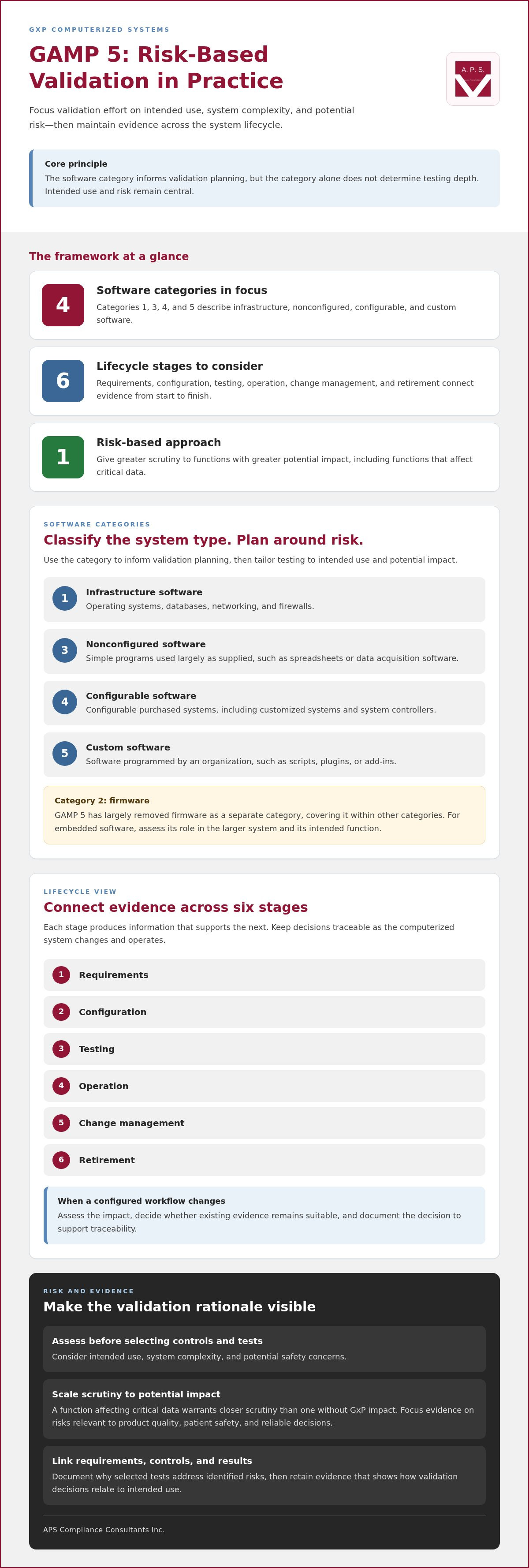
A risk-based approach directs validation effort toward functions with greater potential impact. Under GAMP 5, assess intended use, system complexity, and potential safety concerns before selecting controls and tests. A function affecting critical data warrants closer scrutiny than one without GxP impact. This helps focus evidence on risks relevant to product quality, patient safety, and reliable decisions.
The lifecycle approach considers a computerized system from initial design through decommissioning. For a laboratory information system, consider requirements, configuration, testing, operation, change management, and retirement. Each stage produces information that supports the next. When a configured workflow changes, assess the impact and decide whether existing evidence remains suitable. Documenting the decision supports traceability throughout the system’s working life.
GAMP software categories describe system types and inform validation planning. Category 1 covers infrastructure software, including operating systems, databases, networking, and firewalls. Category 3 covers nonconfigured software, typically simple programs used largely as supplied, such as spreadsheets or data acquisition software. Category 4 covers configurable software, including customized purchased systems and system controllers. Category 5 covers custom software programmed by an organization, such as scripts, plugins, or add-ins. The category alone doesn’t set testing depth; intended use and risk remain central.
Category 2 covers firmware, but GAMP 5 has largely removed it as a separate category, covering it within other categories. For embedded software, assess its role within the larger system and intended function. GAMP 5 also uses Computer Software Assurance principles as a flexible, risk-based alternative to the earlier focus on computer system validation. In practice, document why selected tests address identified risks, then retain evidence connecting requirements, controls, and results. This gives reviewers a clear path from a system’s intended use to its validation decisions.
GAMP guidance recommends greater attention to areas with the highest risks or safety concerns, and more extensive validation for more complex systems. This supports a proportionate plan: focus scrutiny on higher-risk functions and match the validation effort to system complexity. Make the rationale clear in the selected controls and tests so the work reflects the identified concerns and the system being assessed.
How is “gamp” pronounced?
“Gamp” is pronounced as one syllable and rhymes with “camp.” It starts with the hard /g/ sound, as in “go,” and ends with the consonant cluster /mp/. In many English accents, its vowel is the short “a” sound heard in “map.” A common phonetic representation is /ɡæmp/.
To pronounce it clearly, start with the vowel in “map,” then add the opening sound in “go.” Finish with the closing sounds in “lamp.” The result is “gamp,” not “game” or “gamp-ee.” It has no extra syllable, making it a one-beat noun in a sentence such as, “She opened her gamp in the rain.”
For pharmaceutical use, GAMP is commonly spoken as the same word, “gamp.” Add the number in GAMP 5 as a separate spoken word: “gamp five.” In a meeting, that helps distinguish the guidance from a string of individually spoken letters. The written acronym remains capitalized as GAMP, while the British umbrella noun is usually lowercase. Context and capitalization clarify which term you mean.
Try this distinction aloud: say “a gamp by the door,” then “GAMP 5 guidance.” The first example names an object; the second refers to pharmaceutical guidance. Both use the same one-syllable pronunciation, so the surrounding words signal the intended subject. In written material, capitalization provides another cue, especially when both terms appear close together in a discussion or glossary.
When reading aloud, pronounce the word without adding a final vowel. “Gamp” ends with the /mp/ sound, as in “lamp,” while “gamp-ee” turns it into two syllables. In presentations, say “GAMP five” smoothly, with a brief pause between the acronym and numeral. This keeps the spoken form clear and distinguishes the everyday noun from the technical reference.
APS Compliance Consultants: Computer System Validation (CSV)
APS Compliance Consultants Inc. supports GxP-regulated teams with Computer System Validation (CSV) when a computerized system needs documented evidence of suitability for its intended use. This is the practical next step when GAMP 5 principles need to be translated into project requirements, risk assessments, testing, and controlled records.
For a laboratory or production system, validation connects intended use with critical functions and the evidence needed to assess them. A risk-based validation strategy focuses testing on functions that could affect critical data or processes. APS works collaboratively with your team to develop and execute a validation approach that supports compliance and audit readiness.
If your system or validation project needs structured support, contact APS Compliance Consultants Inc. to discuss your requirements.
Turn GAMP 5 principles into practical controls
Knowing the gamp meaning is useful; applying GAMP 5 calls for decisions grounded in each system’s intended use, risks, and lifecycle. Start by identifying which computerized systems support GxP activities, then clarify their critical functions and the evidence needed to show they perform as intended. This gives your team a practical basis for planning validation and maintaining audit-ready records as systems change.
APS Compliance Consultants Inc. provides Computer System Validation (CSV) services. For related operational needs, Alleye CMMS Software supports maintenance management, while PharmaRockIT LIMS supports laboratory information management. Choose support based on the system and process you need to control, rather than treating every technology as the same validation challenge.
Discuss your validation needs and next steps with APS Compliance Consultants Inc.. A focused conversation can help you identify a practical path forward and strengthen confidence in your GxP systems.
Frequently Asked Questions
What does “gamp” mean?
“Gamp” is a British English noun for a large umbrella; informally, it can also describe one tied up untidily. In “Leave your gamp beside the entrance,” it means an umbrella. Capitalized GAMP has a different meaning in pharmaceutical contexts: it refers to industry guidance for computerized systems, not an umbrella or a particular software product.
What is the origin and history of the word “gamp”?
The umbrella word is associated with Sarah Gamp, a character in Charles Dickens’s Martin Chuzzlewit, who carries a large cotton umbrella. Merriam-Webster dates the first known use of “gamp” to 1855, while the umbrella sense is also dated to 1860-65. These dates refer to recorded word use and the dated sense, not necessarily the first time anyone said it.
What is GAMP 5 and what is it used for?
GAMP 5 is ISPE guidance for applying a risk-based approach to GxP computerized systems. Teams use it to plan validation around intended use, system complexity, and potential risk, then maintain relevant evidence as systems change. It supports sound validation decisions, but it doesn’t replace an organization’s site procedures or approval process. For example, teams can use it to justify testing focus for a configured laboratory workflow.



Comments