

Remediate Data Integrity Findings Through ALCOA+ Practices
Missing or unreliable data can compromise the credibility of GxP records, weaken quality decisions, and leave an organization unable to demonstrate what happened and when. To remediate data integrity findings, assess the affected records, systems, and processes, prioritize risks, and document corrective actions while preserving original data and traceability.
The concern is understandable: changing a procedure alone will not resolve a problem rooted in system configuration, access practices, or day-to-day work. A sustainable response connects ALCOA+ principles with appropriate controls, validated processes, audit-trail review, and follow-up monitoring.
This article explains how ALCOA+ helps assess data, what to examine when findings affect electronic or paper records, and how access controls and audit trails support reliable documentation. It also explains where checksums and cryptographic hashing can help verify that data has not changed, and why these techniques complement rather than replace procedural and technical controls. You’ll learn how a risk-based remediation program can move from defining the scope of a finding to correcting its causes and checking that improvements last.
Table of Contents
Constraints, checksums, access control, and audit trails
To remediate data integrity findings, document the affected records, investigation, approved corrective actions, and effectiveness checks. Inspection-ready evidence may include audit-trail extracts, access records, training documentation, and completed test results.
Constraints and Checksums
Data constraints define permitted values and formats before entry. Range checks flag outliers, format checks reject malformed fields, and referential integrity checks expose broken relationships. A checksum compares a calculated value with its stored value, helping detect unintended changes. These controls matter because errors caught during entry are easier to investigate than defects discovered in reports. Define valid ranges and formats before implementing checks.
Access Control and Audit Trails
Access control limits system functions and records to authorized users, while audit trails document changes. Under 21 CFR Part 11 section 11.10(e), electronic systems must have secure, computer-generated, time-stamped audit trails. Section 11.10(d) addresses authorized access, and section 11.10(g) addresses authority checks. Sections 11.10(b) and 11.10(c) address accurate, complete copies and record protection throughout retention. Review who acted, what changed, when, and why.
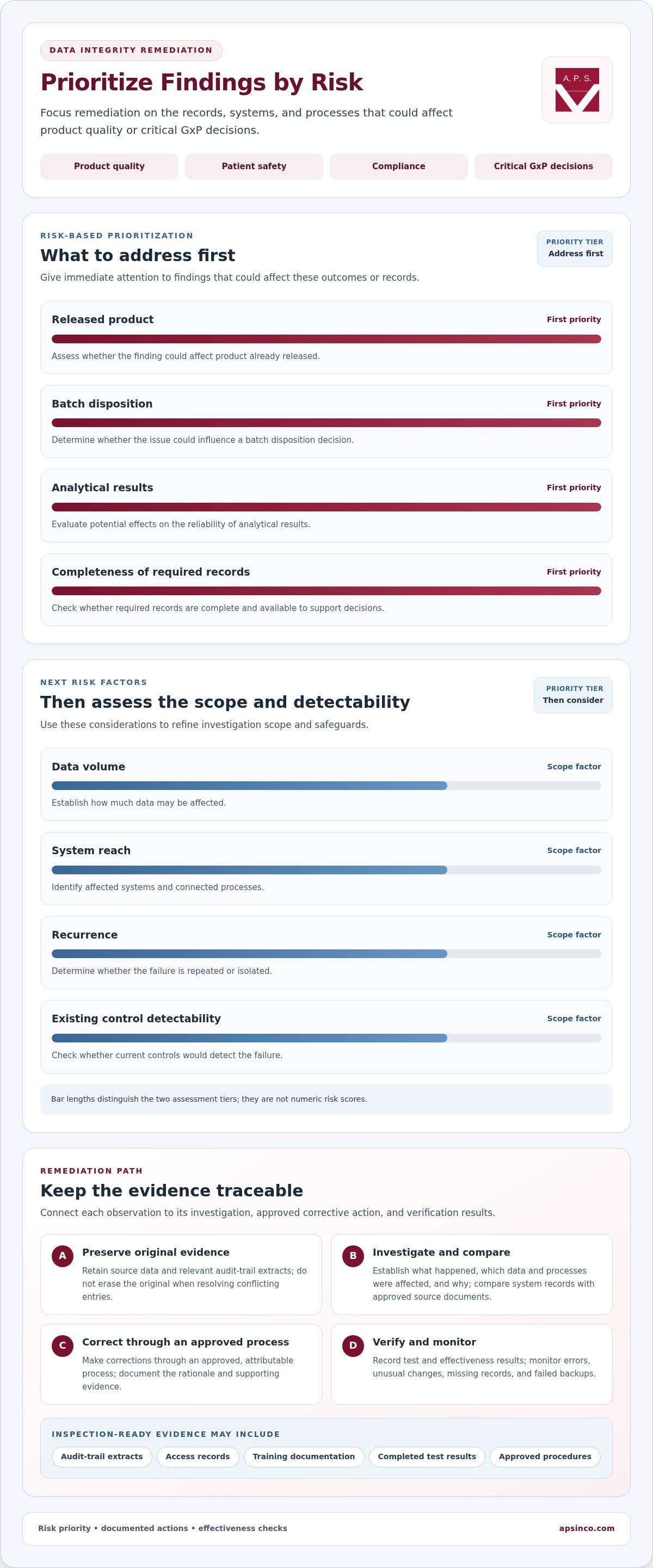
Evidence to remediate data integrity findings should connect each observation to its investigation, corrective action, and verification results. Preserve original data alongside relevant audit-trail extracts, approved procedures, test evidence, and training records. Document how reviewers assessed accuracy, consistency, and completeness, including any reconciliation. This evidence package helps inspectors trace an issue from detection through closure and understand the rationale for each action.
Include unmanaged devices in system inventories and risk assessments. Test data transfers between instruments, workstations, and repositories; check access, clock settings, backups, and transfer controls. Under 21 CFR §211.68, backup data must be exact and complete, and secure from alteration, inadvertent erasures, or loss. Record device owners, gaps, containment actions, and retest results.
Ongoing oversight helps detect recurrence after corrective actions are closed. Set monitoring metrics for errors, unusual changes, missing records, and failed backups. Assign review responsibilities and document the results. Regular audits should assess technical controls and operational practices, including adherence to approved data-entry procedures. When trends emerge, document an investigation and update controls or training based on its findings.
Data integrity remediation for pharmaceutical systems
Build remediation on a complete system registry, clear data criticality, and governance across enterprise and locally managed platforms. These foundations help organizations focus investigations and corrections on failures that could affect product quality, records, or GxP decisions.
Legacy-System Data Inconsistencies
Legacy-system inconsistencies are mismatches, omissions, or duplicates that arise when records move between older applications, databases, or paper files. One platform’s data may not reconcile with another’s, even when each database appears internally consistent. Inventory data sources, map shared fields, and compare records using stable identifiers. Preserve source records, document transformation rules, and flag unresolved differences instead of silently overwriting values.
Prioritizing Findings by Severity and Risk
Risk prioritization ranks findings by their potential impact on product quality, patient safety, compliance, and critical GxP decisions. Address first any issue that could affect released product, batch disposition, analytical results, or the completeness of required records. Then consider data volume, system reach, recurrence, and whether existing controls detect the failure. Record the rationale, affected systems, and interim safeguards so Quality can review priorities consistently.
Investigation and Data Correction
An investigation establishes what happened, which data and processes were affected, and why the failure occurred. Preserve source evidence, compare system records with approved source documents, and trace transfers across platforms. Correct inaccurate or incomplete values only through an approved, attributable process. Identify duplicates and reconcile conflicting entries without erasing the original. Document each change, its rationale, supporting evidence, and verification that confirms the corrected record is accurate.
Ownership and Remediation Timelines
Assign one accountable owner to each finding, with named contributors from Quality, system administration, laboratory operations, and data governance as needed. Set target dates according to risk, investigation scope, system dependencies, and safeguards required during remediation. Track milestones for containment, root-cause analysis, correction, testing, and effectiveness review. Escalate missed milestones through defined governance, and retain decisions and approvals in the finding record.
For cross-platform or legacy-data issues, a focused data integrity discussion can help clarify remediation scope and ownership.
ALCOA+ principles and documentation practices
ALCOA+ gives teams a practical framework for evaluating whether GxP records remain reliable from creation through retention. Apply it to affected data and procedures before selecting controls or corrections. When teams remediate data integrity findings, these principles help connect each corrective action to the record’s intended use and the quality decision it supports.
ALCOA+ Principles and GxP Requirements
ALCOA+ is a set of data-quality principles for assessing records in GxP work. Each principle tests whether evidence can support a critical decision. FDA defines ALCOA as Attributable, Legible, Contemporaneous, Original, and Accurate. ALCOA Plus adds Enduring, Available and Accessible, Complete, Consistent, Credible, and Corroborated. Together, these principles help teams identify gaps that procedures or system controls must address across the data lifecycle.
For electronic records, 21 CFR Part 11 is relevant to data integrity remediation. Use ALCOA+ to evaluate records and supporting processes against their intended use, rather than treating the principles as a standalone checklist. A record may be legible but incomplete if associated raw data or processing details are missing. Document the gap and assess its effect on the related GxP decision.
ALCOA Principles and Data Provenance
Data provenance is the traceable history of a record, including its source, creation, processing, and subsequent changes. ALCOA principles matter because they connect data to the person, time, and process that produced it. For an analytical result, retain source data and its link to the reported value. 21 CFR Part 211.194 covers laboratory records, including complete analytical data and raw data.
Trace a representative record from its source through review and reporting. Confirm who created it, when the activity occurred, and whether later processing remains attributable. If a result moves between systems, retain enough context to understand the transfer and verify the reported value against its source. This trace supports investigation when records conflict or unexplained changes appear.
ALCOA+ Documentation Practices
ALCOA+ documentation practices translate principles into procedures for creating, reviewing, correcting, and retaining records. They matter because staff need consistent instructions for documenting critical activities. FDA regulations require certain activities to be documented at the time of performance under 21 CFR §§211.100 and 211.160. EU GMP guidance also calls for records to be completed when each action is taken.
To remediate data integrity findings, define required fields, review steps, correction methods, and retention practices in approved procedures. Under 21 CFR Part 11 section 11.10(k), documentation controls include change control. For a correction, preserve the prior entry, record the reason, and make the change attributable. Reviewers can then verify the original information, correction, and approval without losing the record’s history.
Checksums, hashing, and cryptographic signatures
Cryptographic verification can help detect data changes, but it cannot establish whether the source information was truthful. Pair hashing, signatures, and validation with controlled data-entry practices so integrity checks address both record alteration and entry errors.
A checksum or hash is a calculated value used to detect whether a data block has changed. SHA-256, for example, creates a digital fingerprint that can be recalculated and compared during transfer or review. A mismatch produces a warning for investigation, not proof of its cause. Record the expected value, comparison result, affected file, and follow-up analysis so reviewers can trace the finding.
Cryptographic signatures can associate a signer with a record and help reveal subsequent changes. Their value depends on controlled credentials, authorization, and procedures that preserve the link between the signed content and its signature. They do not establish that the underlying laboratory result is accurate. Assess signatures within the intended workflow and validated system, including how users authenticate and how reviewers verify the meaning of each signature.
Prevent errors at the point of creation. Define permitted values and formats for each critical field, then implement checks before the record is saved. For example, a required date field can reject an invalid format, while a range check can flag an implausible instrument result. Test each rule with valid and invalid entries, and document expected outcomes, observed results, and approved changes. This makes data validation part of the workflow rather than a later analysis task.
Training supports consistent use of these controls. Teach authorized users how to enter records, respond to validation warnings, protect credentials, and report unexpected system behavior. Pair training records with authorization reviews and periodic testing of roles to ensure permissions reflect assigned duties. If a user can bypass a check or approve their own change, assess the control design and investigate affected records.
Need to evaluate hashing, signatures, or entry validation in a GxP workflow? Discuss data integrity controls with a compliance specialist.
APS Compliance Consultants Inc.: Computer System Validation (CSV)
APS Compliance Consultants Inc. supports pharmaceutical, biotechnology, and medical-device teams when data integrity findings point to gaps in system functionality, validation evidence, or controlled processes. Its Computer System Validation (CSV) services help assess whether computerized systems perform their intended functions and whether validation documentation addresses identified risks.
For findings involving laboratory or maintenance platforms, PharmaRockIT LIMS and Alleye CMMS Software may fit the remediation context. Equipment Qualification (IQ/OQ/PQ) can address related equipment qualification needs. The PharmaRockIT platform has fully documented V-Model validation, including executed IQ and OQ with objective evidence.
Engage APS Compliance Consultants Inc. when your investigation requires structured validation support to connect system risks, test evidence, and corrective actions. Contact APS Compliance Consultants Inc. to discuss your remediation needs.
Turn Remediation Into Sustained Data Governance
Once corrective actions are complete, make effectiveness part of routine quality oversight. Assign responsibility for monitoring the controls introduced, reviewing recurring data issues, and escalating signs that a process or system is drifting from its approved state. This ongoing ownership helps prevent a closed finding from becoming a recurring weakness.
Connect each corrective action to evidence demonstrating that it works in daily operations. Use that evidence to inform future risk reviews, staff guidance, and decisions about system changes. Treat remediation as a practical improvement to how your team creates, reviews, and maintains GxP records, not as a file closed after an inspection.
When your team needs support aligning system validation with data integrity remediation, contact APS Compliance Consultants Inc. to discuss your next steps. A clear plan can help your organization strengthen oversight and move forward with confidence.
Frequently Asked Questions
What Is the Impact of the Absence of Data Integrity?
Without reliable records, teams cannot confidently use results to support quality decisions. For example, if an analytical result cannot be linked to its source data and review history, it becomes difficult to establish whether the result is suitable for a batch decision. Gaps can also complicate investigations and inspection responses because staff may be unable to reconstruct what happened, which records were affected, or how conclusions were reached.
What are common data integrity findings in audits and assessments?
Common findings include missing raw data, undocumented repeat testing, unexplained result changes, incomplete records, shared user credentials, and discrepancies between source records and reports. For example, a printed chromatogram without accessible electronic processing information may prevent reviewers from tracing how the reported result was produced. Findings can also involve unclear procedures, inconsistent practices between sites, or insufficient documentation of corrections and reviews.
How should data be validated after remediation?
Validate affected requirements with a documented test plan linked to the corrective action. For a changed calculation, test representative inputs, boundary conditions, and expected outputs, then compare the results with approved specifications. Include negative tests where an invalid entry should be rejected or flagged. Record test data, observed results, deviations, and approvals. Assess whether the change affects related functions before closing the remediation record.
What controls prevent data integrity findings from recurring?
Prevention depends on controls that remain part of routine operations. Define role-based permissions, documented change approval, periodic review responsibilities, and task-specific training. Trend recurring deviations, failed transfers, and correction patterns through quality oversight. For example, repeated missing fields may point to a form-design problem rather than isolated user error, prompting a workflow change alongside retraining and follow-up review.
What are common data integrity requirements under FDA 21 CFR Part 11 and ALCOA+?
In applicable electronic-record systems, FDA 21 CFR Part 11 addresses system validation, accurate and complete copies, record protection, authorized access, audit trails, authority checks, and documentation controls. ALCOA+ provides a data-quality lens for assessing attribution, legibility, timing, originality, accuracy, completeness, consistency, and availability. Apply both when reviewing how a regulated record is created, processed, approved, retained, and retrieved.
What are the risks and consequences of unresolved data integrity findings?
Unresolved findings can weaken confidence in records used for laboratory, manufacturing, or quality decisions. If affected data supports a product decision, the organization may need to assess the records and decisions involved, document the impact, and determine appropriate actions through its quality system. Persistent gaps can also make inspection responses harder to support and allow the underlying process or system weakness to continue affecting records.



Comments